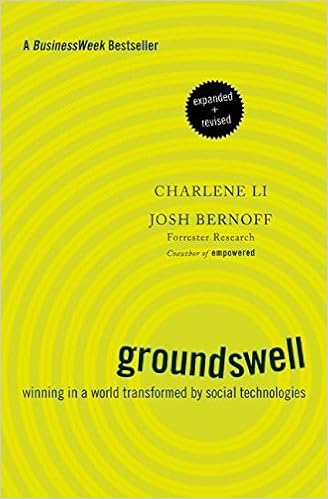
First off, I'm sure we're all a little confused about what groundswell is. I know hearing the word for the first time made me question whether I had been sitting in the right classroom and that this was in fact Social Media Marketing and Communications. Groundswell is defined (in the book Groundswell: winning in a world transformed by social technologies by Charlene Li and Josh Bernoff) as "a spontaneous movement of people using online tools to connect, take charge of their own experience, and get what they need---information, support, ideas, products, and bargaining power--- from each other. (intro, page xi)" I know, super official and a great definition, but let's talk about what this might actually mean and why this might be happening.
Instantly, one key part stood out to me above the rest; "people using online tools to connect". While technology is obviously a factor to keep in mind, the focus of that sentence lies in the word "connect." Groundswell stems from one simple fact; relationships are everything. This monumental shift in our way of approaching interactions is happening because we want to connect with each other. People want to stay in contact with those they know and our technology is advanced enough to allow that to happen. On top of that, we want to create relationships with the companies and stores we frequent. These organizations are sometimes so massive that being able to put a human connection behind the logo makes a world of difference.

Anyone with a working computer and a decent internet connection can, for example, log onto Facebook and make a profile. This individual (let's call him user 1) can sit online, never add a single friend or make a single connection, but would still be considered as part of the Facebook interface. If someone were to come up and ask this person "are you on Facebook", the answer would be yes. If they were then asked their opinions of the site, it may be wildly different than someone like user 2, who is taking full advantage of the features available, stays in touch with their entire rugby team, and is constantly posting about the wonders of Alan Tudyk's acting career. This is where reviews and the ability to share our opinions comes into play, which was highlighted significantly in chapter two of the book.
A clip from the documentary "Cyber-seniors". Thought it was pretty funny, so I put it in
Let's pretend that user 1 and user 2 both wrote reviews of Facebook and their time spent on the site. User 1's review, which spoke negatively about the website due to lack of engagement and minimal . They did not make any connections through Facebook's extensive network and have not spent much time online. This individual's review would probably be dismissed by someone looking to join the "Social Network" due to the fact that user 1 is not actively involved or utilizing the site to it's potential. User 2's review, which was also more negative, has a higher credibility simply because this individual has spent more time on the site. They have made the most of the features provided, but still have some critiques about it as a whole.
Companies can try to shape what they want their service to provide. They can lay the foundation for intended usage and create a mission statement that backs their beliefs. Once that service is released; however, the opinions and reflections of that site now lie in the hands of their consumers. Reviews create a feedback loop, with the most recognized and accepted ones filtering their way to the top. A service that receives consistently negative reviews may struggle to attract new users, whereas a string of positive reviews may continue to succeed as time goes on. Thats not to say that reviews don't help out companies, especially since many of them rely on feedback to improve and update their services. Groundswell has merely provided a space where users can trust each others critiques and praise over what a company is trying to portray.
Do you believe that having a space free from companies opinions and influences to review services online is a good idea? Let me know down below!
Also, just for fun, here's this random paragraph I started writing about Wikipedia. I decided to go with my Facebook example, but thought it was still funny enough to keep in. I really wanted to talk about Alan Tudyk, who's work you should definitely check out.
"Let's take a look at a site like Wikipedia, where users can add their own input to pages of information ranging from the Great Chicago Fire of 1871 to a page entirely dedicated to teaching us about all the different roles Alan Tudyk has played over the years. The brilliance behind a wiki based site is that anyone can add their two cents, but the process behind that access is relatively restricted. Not all changes will be approved, especially if those contributions contradict accepted facts or are blatantly stated as opinions. Anyone can write on Alan Tudyk's page that he was the voice behind Heihei, the chicken in the film Moana. What might not be allowed is if Alan Tudyk went to Wikipedia and changed his page to say that he was, in fact, the worlds greatest actor. If word got out that the main man himself was responsible"
